
Reviewed · CITY TOURS
Hop-on Hop-off or Night Tour Tourist Bus in Mexico City
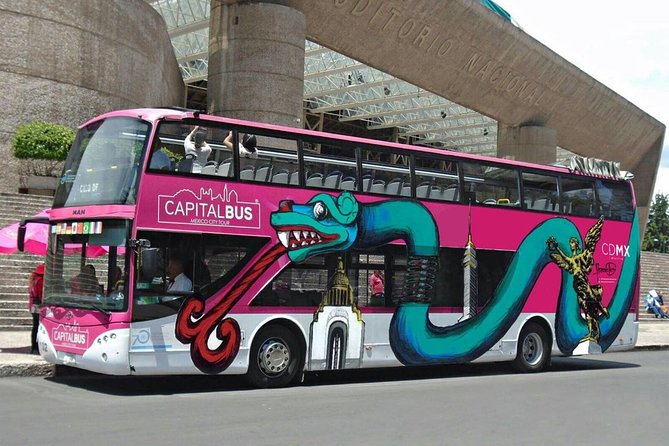
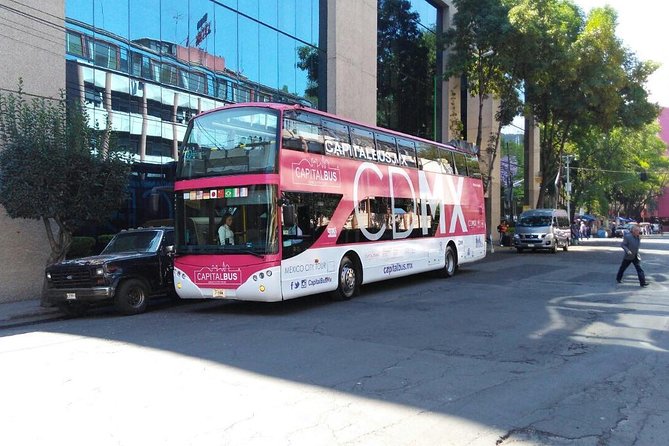
See Mexico City from above. This open-top, double-decker bus is a useful first look at a huge city, especially if you want to cover major landmarks without solving the transit system on your first morning. I like the unobstructed views and the freedom to hop off during the 24-hour ticket period. I also like the onboard English commentary, which gives each district some context as you pass. The main drawback is the middling 3 out of 5 rating from 127 reviews, so I would treat this as a practical orientation ride, not a polished guided tour.
Your ticket is most useful when you plan a few well-chosen stops rather than staying on the bus all day. Start at the listed Zócalo meeting point, check the exact route and departure time, and remember that traffic can make Mexico City sightseeing slower than the timetable suggests.
In This Review
- Key points before you ride
- Why this bus can be a smart first look at Mexico City
- Begin at the Zócalo and get your bearings
- Paseo de la Reforma brings the monuments into view
- Chapultepec is the best place to turn a bus ride into a full day
- Polanco shows a newer, more polished side of the city
- Lincoln Park offers a quieter Polanco pause
- Auditorio Nacional adds a major cultural landmark
- How to use the 24-hour ticket without wasting it
- Who gets the most value from this experience?
- Value, flexibility, and the middling rating
- Should you book the Mexico City bus?
- FAQ
- Where does the tour start?
- Where does the tour end?
- How long is the experience?
- What are the operating hours?
- Is the tour offered in English?
- Can I get off the bus and board again?
- What is the cancellation policy?
Key points before you ride
- Start at the Zócalo stop: The stated meeting point is Parada Capital Bus Zócalo on Monte de Piedad in the Historic Center.
- Use the 24-hour validity well: You can hop off and back on as often as you like during the ticket period.
- Ride above the traffic: The open upper deck gives you clear views of monuments, parks, avenues, and modern districts.
- Make time for Chapultepec: The park connects the bus ride with some of Mexico City’s best museums, including the National Museum of Anthropology.
- Polanco changes the mood: Plaza Carso, Museo Soumaya, Museo Jumex, Lincoln Park, and Auditorio Nacional show a more modern and affluent side of the city.
- Expect a city overview, not door-to-door transport: Regular buses help, but the service still operates in a very large and traffic-heavy capital.
Why this bus can be a smart first look at Mexico City
Mexico City is too large to understand from a single neighborhood. The Historic Center, Paseo de la Reforma, Chapultepec, Polanco, and newer commercial areas each have a different feel. An open-top bus lets you connect them without spending your first day studying maps, transfer points, and unfamiliar streets.
I especially like this kind of ride for a first day. You can see where the major areas sit in relation to one another, then return to the places that deserve more time. It is also useful if your group has mixed interests. One person can focus on museums, another on shopping, and someone else can simply enjoy the view from the upper deck.
The English audio commentary adds value, though you should keep your expectations in check. It gives you background while the city moves past, but it does not replace a guide who can answer questions or adjust the route to your interests. Think of it as a moving introduction.
The 24-hour ticket is the strongest practical feature. You do not have to cram every stop into one long circuit. You can ride for a while, get off for a museum or meal, and continue later within the validity period. The listed operating hours are 9:15 AM to 8:00 PM, Monday through Sunday, so your usable touring window is tied to those service hours.
More Evening Tours in Mexico City
- Lucha Libre Tickets & Tacos & Beer & Mezcal – BEST NIGHT EVER!
★ 5.0 · 1,077 reviews - Mexico City: Double Decker Bus Night Tour
★ 3.8 · 373 reviews - A Night of Tacos and Mezcal in Mexico City
★ 5.0 · 262 reviews
Begin at the Zócalo and get your bearings
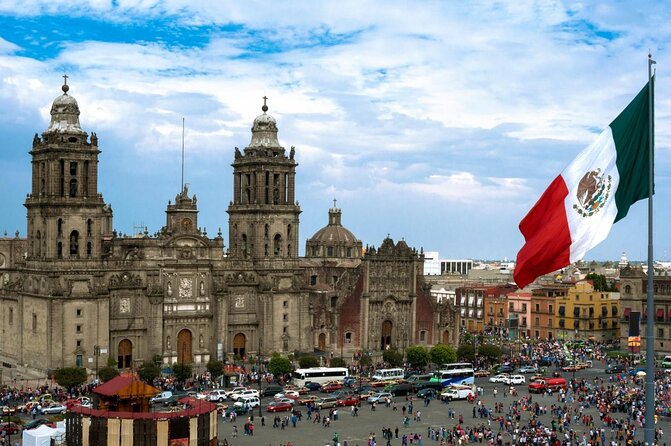
The listed starting point is Parada Capital Bus Zócalo, on Calle de Monte de Piedad in the Centro Histórico. This is an excellent place to begin because the Zócalo is one of the clearest reference points in Mexico City.
The huge Mexican flag in the center is hard to miss. The National Palace gives the square a grand civic edge, and the surrounding Historic Center offers a dense mix of major buildings, shops, and places to eat. Even if you do not get off immediately, the bus ride helps you see how the old central district connects with the city’s newer avenues.
I would use the first circuit as a scouting run. Listen to the commentary, watch for the stops that interest you, and avoid trying to photograph everything at once. From the upper deck, you get a better sense of the scale of Paseo de la Reforma than you would from a sidewalk.
There is one practical point to clear up before booking. The general description refers to beginning in Zona Rosa, while the stated meeting point is the Zócalo. Since the details do not fully reconcile those two locations, confirm the departure point for the option and date you select. Do not assume the first stop is the same as the booking location.
Paseo de la Reforma brings the monuments into view
Paseo de la Reforma is one of the most rewarding stretches for a bus ride. The broad avenue links important districts and carries several of Mexico City’s best-known monuments.
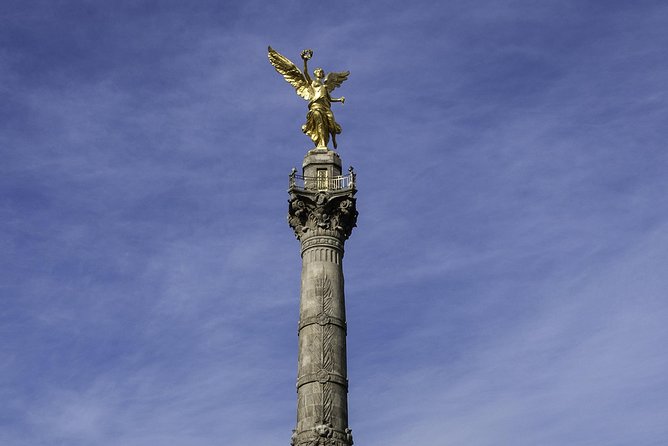
The Monumento a la Independencia, usually called El Ángel, is the key photo stop. It is an honorary column in a traffic circle where Paseo de la Reforma meets Río Tíber, Florencia, and nearby streets. It was inaugurated in 1910 to mark the centennial of the beginning of the Mexican War of Independence.
From the bus, you see the monument in its proper setting, surrounded by moving city traffic rather than isolated in a museum courtyard. That matters because Reforma is meant to be read as a grand avenue, not just a collection of separate statues.
The Diana the Huntress Fountain is another notable sight along Reforma. The sculpture represents the Greek goddess Artemis, or the Roman Diana, and was originally called The Arrow of the North Stars. It is a quick visual moment from the bus, but it adds variety to the avenue’s monuments.
Later, you pass the Cibeles Fountain in the Cuauhtémoc area. This is a replica of Madrid’s Cibeles Fountain, placed at the intersection of Oaxaca, Durango, Medellín, and El Oro streets. It was installed in 1980 as a symbol of friendship between Spanish and Mexican communities and remodeled in 2011.
These are not long museum visits. They are outdoor sights best understood from the route, where you can see their position within the city. If you want detailed photographs, you may prefer to get off and approach them on foot, but traffic and the exact stop arrangement may affect how easy that is.
Chapultepec is the best place to turn a bus ride into a full day

Bosque de Chapultepec is the largest urban park in the Western Hemisphere, and it contains several of Mexico City’s most important cultural sites. The stop is listed with 15 minutes and free admission, but that short time should not be mistaken for the amount of time you need in the park itself.
This is where the hop-on hop-off format earns its keep. Get off, then give Chapultepec the time it deserves. The National Museum of Anthropology is the major draw, and the Tamayo Museum and Museum of Modern Art are also named among the city’s important museums.
You will need to choose carefully. The National Museum of Anthropology alone can take much of a day if you want more than a quick look. The Tamayo Museum and Museum of Modern Art suit different interests, so check their current exhibitions and opening details separately before building your schedule around them.
The park also has archaeological importance. It was declared an archaeological zone, and nearly 4,000 archaeological objects have been found there. That gives the stop more weight than a simple green break between neighborhoods.
The practical drawback is time. You cannot realistically hop off for a major museum, explore it properly, and expect to catch the very next bus. The 24-hour ticket gives you flexibility, but you still need to allow for museum visits, walking, and the possibility of waiting for the next departure.
More hop-on hop-off passes:
- Mexico City: Hop-on Hop-off Bus Tour
★ 4.0 · 1,043 reviews - Mexico City: Hop-on Hop-off City Tour by Turibus 1-Day Pass
★ 4.1 · 691 reviews - Turibus Hop On Hop Off Mexico City Tour
★ 3.0 · 347 reviews - Mexico City: Hop-On Hop-Off Bus City Tour
★ 3.9 · 183 reviews
Polanco shows a newer, more polished side of the city
The route moves from parkland and museums into Polanco, where Plaza Carso provides a very different experience. This large mixed-use development in Nuevo Polanco includes Museo Soumaya, Museo Jumex, and Teatro Telcel.
Plaza Carso works well for a planned stop because several attractions sit within one modern complex. Museo Soumaya is the best-known name here, while Museo Jumex adds a contemporary art option. If you want a break from historic buildings and traditional plazas, this is where Mexico City’s newer architectural and cultural side comes forward.
The development also offers places to eat and shop, though the information provided does not specify individual restaurants, store hours, or admission arrangements. Plan to check those details separately if they matter to your day.
The route also takes you across Avenida Moliere. That stretch gives you a chance to see the important sites around the avenue rather than treating Plaza Carso as an isolated stop. I would stay alert here, since the upper deck is good for taking in the relationship between large modern developments and the surrounding streets.
Lincoln Park offers a quieter Polanco pause

Lincoln Park sits in the southern part of Polanco, in the Miguel Hidalgo area. It was the first park designed for the colony, with another park later placed on Horacio Avenue in front of the San Agustín Parish.
The park is surrounded by some of Polanco’s early mansions and apartment buildings, along with newer offices and residential towers. That mixture makes it a worthwhile stop for architecture and neighborhood atmosphere, not just for a short rest.
Compared with the grand scale of Reforma or the large museums in Chapultepec, Lincoln Park is more local in character. The supplied timing does not identify a formal admission charge, and the park itself is free to enter. You can use it as a breathing space between larger attractions.
Still, I would not make Lincoln Park the main reason for buying the ticket. It is most useful as part of a Polanco sequence that includes Plaza Carso or Auditorio Nacional.
Auditorio Nacional adds a major cultural landmark
Auditorio Nacional is Mexico’s principal presentation venue and one of the world’s important performance spaces. Its reputation rests on the quality of its artistic programming, the number of people it accommodates, the performances it hosts, tickets sold, and its audiovisual facilities.
The bus stop gives you a look at the building and its place in the city’s cultural life. The listed stop duration is 15 minutes with free admission, but attending a performance is a separate matter and is not included in this bus experience.
If you are already planning to see a show, the stop may be especially useful for orientation. If not, treat it as an exterior landmark rather than a full venue visit. The bus cannot turn a performance hall into a quick sightseeing attraction.
The nearby Reforma monuments and Chapultepec sites also make this part of the route easy to combine. You can use the bus to connect the performance district with museums and parks instead of arranging several separate rides.
How to use the 24-hour ticket without wasting it
A hop-on hop-off ticket has value only when you hop off. If you remain seated for one complete circuit, you are buying a moving overview. That can still be useful, but it is less economical than using the bus to reach two or three places you planned to explore.
I would divide the day into zones:
- Begin at the Zócalo and ride through the central areas.
- Spend the longest stop in Chapultepec if museums are a priority.
- Continue to Polanco for Plaza Carso, Lincoln Park, or Auditorio Nacional.
- Use Reforma for monuments and broad city views.
- Return to the bus when you want a break from walking.
The service is described as regular, but no exact interval is supplied. That means you should not build a tightly timed chain of museum admissions around a promised departure minute. Keep some slack in the plan, especially because Mexico City traffic can affect any road-based tour.
The open upper deck is the best place for views, but conditions may change during the day. The vehicle is double-decker and open-top, so you should choose your seat with sun, wind, and weather in mind. If you want uninterrupted sightlines for monuments and photographs, the upper deck is the obvious choice when available.
Who gets the most value from this experience?
I would recommend this bus to a first-time visitor who wants a broad introduction before choosing where to spend deeper time. It also suits anyone who prefers not to arrange several separate taxi or public transportation journeys across distant districts.
Families and mixed-age groups may appreciate the simple structure. Most people can participate, the bus is near public transportation, and the maximum group size is listed as 45 travelers. That is not a small private tour, but it is manageable for a city transport experience.
The bus is less suitable if you want detailed historical interpretation, personal attention, or a carefully paced walking tour. The audio commentary is useful, but you remain responsible for deciding when to get off and how long to stay.
It may also disappoint visitors who expect every famous sight to be directly beside a stop. A big city route shows you the connections between districts, but some landmarks still need a walk after you leave the bus.
Value, flexibility, and the middling rating
No price is provided here, so I cannot judge the ticket against a specific dollar amount. The value depends on how much use you make of the 24-hour period and how many separate rides you would otherwise arrange.
The strongest case for buying it is flexibility. You can cover Zócalo, Reforma, Chapultepec, and Polanco with one sightseeing plan, while also receiving English commentary and upper-deck views. If you use several stops, the ticket can save time and reduce the mental work of planning.
The caution is the overall 3 out of 5 rating from 127 reviews. That score is neither a clear endorsement nor a reason to reject the experience automatically. It tells me to pay close attention to the exact departure point, route option, operating hours, and bus timing before committing your entire day to it.
Free cancellation is available up to 24 hours before the start time, with a full refund. Changes or cancellations made within 24 hours are not accepted for a refund, and the cut-off follows local Mexico City time.
Should you book the Mexico City bus?
Book it if you want a simple first survey of Mexico City, especially with stops in Chapultepec, Polanco, and along Paseo de la Reforma. The open upper deck and 24-hour flexibility are genuinely useful, and the route connects districts that are too spread out for casual walking.
Skip it if you want a deep, personal tour of the city or if your schedule is so tight that traffic and waiting could cause problems. Before booking, confirm whether you are choosing the daytime hop-on hop-off service or a night option, and verify the starting point because Zona Rosa and the Zócalo are both referenced in the supplied details.
For a first day, I would use the bus as a map you can ride through. Let it show you the city’s scale, then get off where your curiosity takes you.
FAQ
Where does the tour start?
The stated meeting point is Parada Capital Bus Zócalo on Calle de Monte de Piedad in the Centro Histórico of Mexico City.
Where does the tour end?
The experience ends back at the meeting point.
How long is the experience?
The tour duration is approximately 1 to 11 hours, while the ticket is valid for 24 hours.
What are the operating hours?
The service is listed as operating Monday through Sunday from 9:15 AM to 8:00 PM.
Is the tour offered in English?
Yes. English is listed as an available language for the experience.
Can I get off the bus and board again?
Yes. The ticket allows you to hop off as many times as you like during the 24-hour validity period.
What is the cancellation policy?
You can cancel at least 24 hours before the experience start time for a full refund. Cancellations or changes made within 24 hours are not accepted for a refund.
More After-Dark Outings
- Mexico City: Night City Tour in a Double Decker Bus
★ 4.2 · 235 reviews - Narvarte At Night: Tacos, Chelas & Mezcal
★ 5.0 · 216 reviews - 3-Hour Night Tacos and Mezcal Crawl in Mexico with Guide
★ 5.0 · 195 reviews - Xcaret Park Entry Tickets with Cultural Night Show Included
★ 4.5 · 2,382 reviews
Just added around Mexico City
- Teotihuacan & Anthropology Museum, Templo Mayor & City Tour★ 4.5 · 109 reviews
- Mexico Private Food Tour With Locals Including 10 Tastings★ 4.5 · 109 reviews
- THE REAL CDMX: Under the skin of the city★ 5.0 · 111 reviews
- Mexico City: Mexican Folklore Ballet★ 4.5 · 111 reviews
- Teotihuacán plus Bike Tour★ 5.0 · 114 reviews
- Bike to taste the world’s best tacos – Mexico City★ 5.0 · 116 reviews
- EXCLUSIVE TOUR Chapultepec Castle – Small Groups★ 5.0 · 117 reviews
- Balloon flight with private transportation and guided tour to Teotihuacán★ 5.0 · 118 reviews
City Tours, compared.
Teotihuacan, Tlatelolco & Guadalupe Shrine Tour
Read our review →
Teotihuacan Hot Air Balloon Flight from Mexico City / Volare
Read our review →


The best tour to Teotihuacán from Mexico City
Read our review →

Browse the lists this tour appears in