
Reviewed · HISTORICAL TOURS
Queretaro: colonial architecture and history
Querétaro tells its story in stone. This 3 to 4 hour walking tour links the city’s aqueduct, convents, churches, plazas, and national turning points into one clear morning. I like the way guide Armando Magaña connects local events to Mexican and world history, and I like the small maximum of six people, which leaves room for questions. The main consideration is that the tour leans more toward religious and political history than detailed architectural analysis.
You’ll walk through much of the old center, beginning at the Mirador de los Arcos and finishing near the Museo de la Ciudad. I love that the route gives you useful orientation before you explore alone, especially if Querétaro is new to you. Come ready to walk and listen for several hours, since some reports describe the experience lasting beyond the advertised time.
In This Review
- Key points to know before you book
- Why Querétaro makes a good history walk
- Starting beneath the arches at El Acueducto de Querétaro
- Remembering local figures at the Panteón de los Queretanos Ilustres
- Santa Cruz and the hill where Querétaro was founded again
- Plaza de Armas and the city’s public face
- Guadalupe and the role of devotion in Mexico
- San Francisco and the old inner-land road
- Santa Clara, a remarkable corner of old Querétaro
- Finishing at the Museo de la Ciudad
- Is $50 a fair price?
- Who will enjoy this walk most?
- My call: book it for the story, not just the buildings
- FAQ
- Where does the tour begin?
- Where does the tour end?
- What time does the tour start?
- How long does the experience last?
- What language is the tour offered in?
- How much does the tour cost?
- How many people can join the tour?
- Do the stops require admission fees?
- Is the tour suitable for every fitness level?
Key points to know before you book
- A love story behind the aqueduct: The opening stop introduces Querétaro’s foundation and the personal story linked to the aqueduct’s construction.
- A small group with room for questions: The tour accepts a maximum of six people, a good setup for a history-heavy walk.
- Seven stops across the historic center: Churches, convents, a cemetery, a grand square, and the aqueduct create a broad introduction to the city.
- History comes before architecture: You’ll see Neo-Classical and Baroque buildings, but the main focus is how religion, independence, foreign intervention, and civic life shaped Querétaro.
- An English-language tour with strong storytelling: Armando Magaña is praised for clear English, a lively delivery, patience, and his ability to connect local events to wider history.
- A useful first morning in town: The route ends at the Museo de la Ciudad, a central point where you can continue on foot, take a taxi, or stop for a meal.
Why Querétaro makes a good history walk
Querétaro is not just a pretty colonial center. Its streets and religious buildings are tied to the foundation of the city, Spanish expansion, silver routes, Mexican independence, and the country’s struggle against French rule in the 1860s.
That can be a lot to absorb if you simply wander from church to church. This tour gives you a framework. Instead of seeing an aqueduct as a photogenic row of arches or a convent as another old church, you learn how each place fits into the city’s growth and Mexico’s larger story.
The strongest part of the experience is the guide’s storytelling. Armando Magaña does not appear to treat history as a list of dates. He uses the places around you to explain cause and effect, then adds anecdotes and wider context. This approach suits you if you want to understand why Querétaro mattered, not only what its buildings look like.
The small group matters, too. With no more than six people, you are less likely to lose the thread of a long explanation. You can ask about a monument, a historical figure, or a confusing period in Mexican history without holding up a large group.
More ruins and heritage sites:
- Historical and Cultural Walking Tour of San Miguel de Allende
★ 5.0 · 641 reviews - Historical & Cultural Walking Tour of San Miguel de Allende
★ 4.8 · 225 reviews - Historic Downtown Walking Tour
★ 5.0 · 1,289 reviews
Starting beneath the arches at El Acueducto de Querétaro
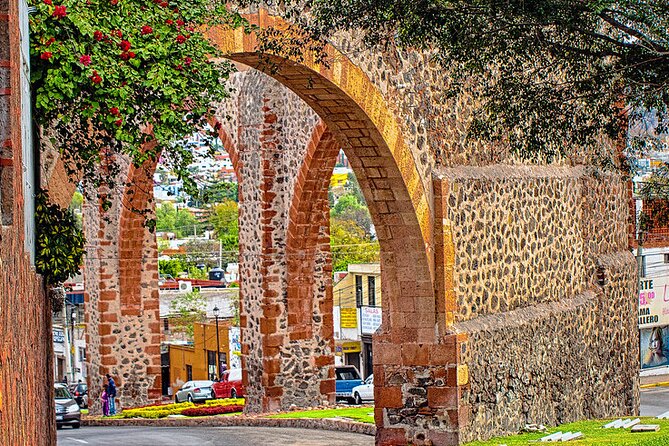
The tour begins at the Mirador de los Arcos, at Ejército Republicano 47. From here, the aqueduct provides an immediate sense of Querétaro’s scale and ambition.
The stop lasts about 15 minutes and does not require an admission ticket. You’ll hear about the foundation of the city and the love story associated with the aqueduct’s construction. That personal angle is a smart way to begin. Grand public works can feel remote, but a human story gives the structure an emotional entry point.
This is also a good place to ask questions about how the aqueduct relates to the city’s early development. The supplied schedule gives the stop a short time, so do not expect an extended engineering lecture or a long architectural study. Its role is to set the scene and start the historical narrative.
If you are arriving from San Miguel de Allende, pay close attention to the meeting address. The experience is listed in connection with San Miguel de Allende, but the actual start point is in Santiago de Querétaro. The tour details do not state that transportation from San Miguel is included, so you should arrange your own way to the Mirador de los Arcos.
Remembering local figures at the Panteón de los Queretanos Ilustres
The next stop is the Panteón de los Queretanos Ilustres, also called the Pantheon of Illustrious Queretans. The visit takes about 15 minutes and is free.
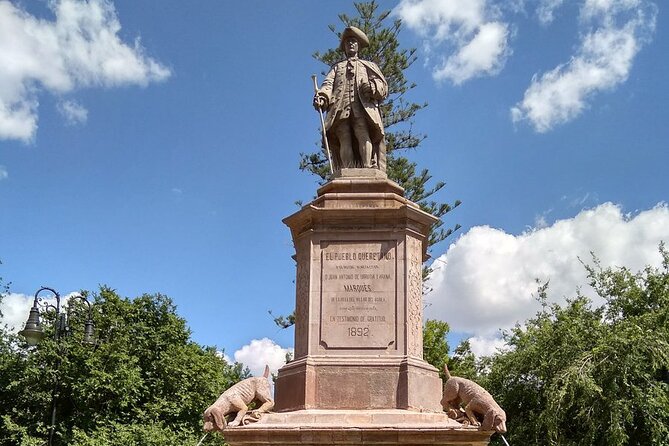
Here, Armando introduces important people buried at the site and explains how their actions affected the history of Mexico. This adds faces and personalities to the wider political story. A city’s past becomes easier to follow when you can connect it to people who made decisions, took risks, or influenced events.
The stop is brief, so you will receive an introduction rather than a full biography of every person associated with the cemetery. Still, it helps show that Querétaro’s importance came from more than its buildings. The city’s role was shaped by individuals as well as institutions.
Santa Cruz and the hill where Querétaro was founded again
At the Templo y Ex-Convento de la Santa Cruz de los Milagros, the tour spends about 40 minutes. This is the longest scheduled stop, and it is easy to see why.
The church and former Franciscan convent sit at the top of the hill where Querétaro was founded for a second time. You’ll hear legends tied to the site, along with national historical episodes in which the Franciscan complex played a part.
This stop is especially useful if you want to understand how religion shaped colonial cities. The convent was not simply a place for worship. Religious orders played major roles in education, administration, conversion, and the organization of settlements. The building becomes a way to discuss those wider forces.
You should also expect stories. Armando’s strongest quality is his ability to make historical links memorable, and this is the sort of place where legends and documented events sit close together. If you want only precise architectural labels, you may find the emphasis uneven. If you enjoy the way buildings open into questions of belief, power, and national change, this should be one of the morning’s highlights.
A few more reviews worth comparing before you book
- Immersive Cañada de La Virgen Pyramid Tour
★ 5.0 · 789 reviews - Original Downtown Food Tour with Taste of San Miguel
★ 5.0 · 598 reviews - Tacos and Tequila Walking Tour with Taste of Miguel
★ 5.0 · 583 reviews - Half-Day Horseback Riding Adventure
★ 5.0 · 417 reviews
Plaza de Armas and the city’s public face
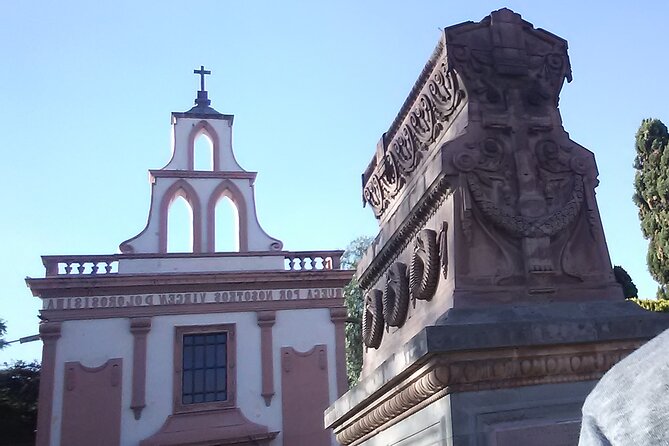
The route then moves toward Plaza de Armas, the picturesque main square. The scheduled visit takes about 35 minutes.
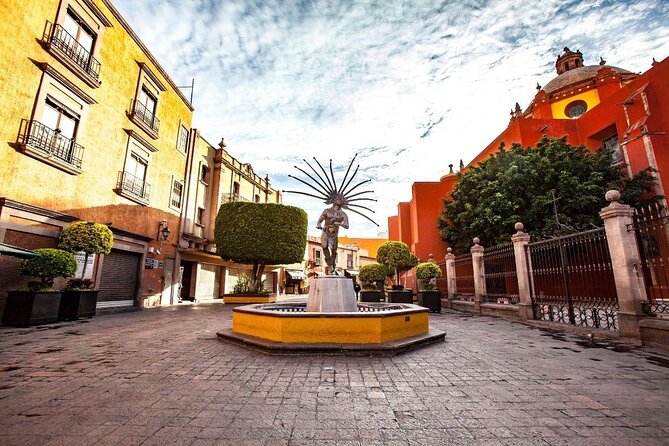
Before reaching the square, the guide points out a couple of Neo-Classical examples. This is where you get some architectural vocabulary, though the tour does not appear designed as a specialist architecture walk. You’ll learn how the buildings relate to the city’s historical periods, then hear more stories in the plaza itself.
A main square is often the best place to understand a colonial city’s civic structure. Around it, religious, political, and commercial life meet. The square also gives you a visual break after the more focused church and cemetery stops.
The route may be affected by festivals or crowds. The tour has handled busy city days successfully, but a crowded plaza can make it harder to hear or inspect details. The small group helps, though you should still stay close to Armando when the center is active.
Guadalupe and the role of devotion in Mexico
At the Santuario de la Congregación de Nuestra Señora de Guadalupe, you’ll spend about 15 minutes. The stop centers on the temple of the Virgin of Guadalupe, the historical importance of this religious figure in Mexico, and the building’s creator.
This is not just a church visit. Guadalupe is a major part of Mexican religious and cultural identity, and the stop gives Armando a chance to explain why the figure matters in national life.
The short timing means you will probably receive the essential story and a focused look at the temple rather than a long interior tour. Even so, it adds an important layer to the morning. The route is not treating religion as decoration. It shows how faith, identity, and politics have overlapped in Mexico.
San Francisco and the old inner-land road
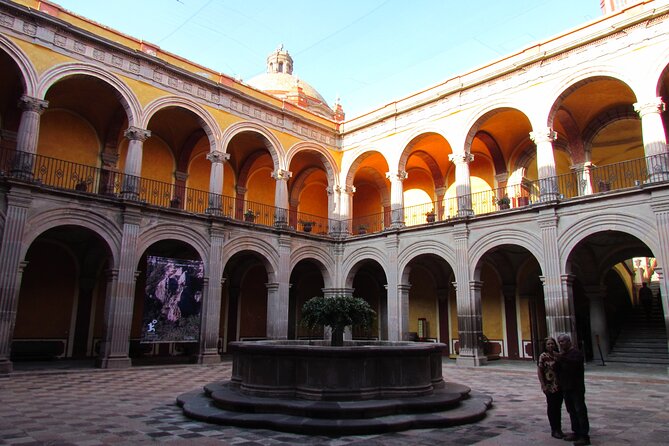
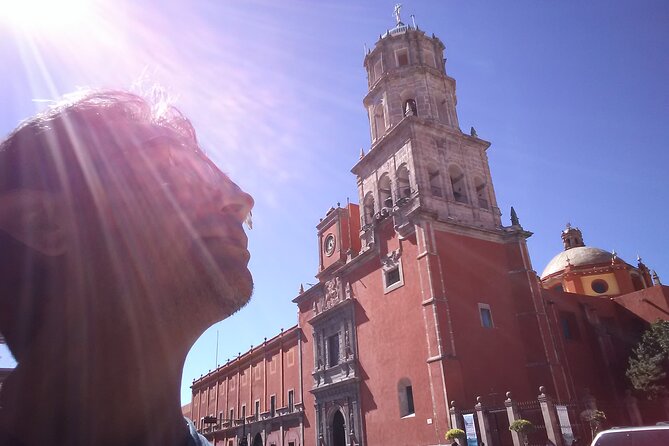
The Templo y Ex-Convento de San Francisco de Asís de Querétaro receives about 15 minutes. From inside the former convent, you’ll learn how the building changed during different periods in the country’s past.
That idea of transformation is valuable. Historic buildings are not frozen objects. They are altered by wars, political changes, new uses, and changing religious institutions. Armando uses the former convent to show how national events can leave marks on a local building.
You’ll also see the place where the old inner-land road began. This detail helps explain Querétaro’s position as a connecting point rather than an isolated colonial settlement. Roads bring trade, people, ideas, and military movement. The city’s importance grew partly from those links.
Again, the stop is short. You’ll get a strong orientation point and historical explanation, but not an exhaustive account of every architectural change.
Santa Clara, a remarkable corner of old Querétaro
The Convento de Santa Clara is the final major stop and lasts about 20 minutes. This single corner brings together several layers of the old city: the first and largest women’s convent, the former city hospital, a notable Neo-Classical fountain, and what is described as the finest example of Baroque private-house architecture.
That concentration makes the stop a fitting ending. You can compare religious architecture, public care, domestic design, and later Neo-Classical taste without crossing half the city.
The convent also broadens the story beyond male religious orders and military events. A women’s convent tells you something about social organization, family expectations, wealth, and religious life in colonial Mexico. The nearby hospital adds another civic function, showing how old neighborhoods served many purposes at once.
For architecture-minded people, this may be the most satisfying part of the route because several styles and building types appear side by side. Still, the tour’s overall focus remains historical. Ask Armando direct questions if you want more detail on Baroque decoration, Neo-Classical design, or the changes made to particular buildings.
Finishing at the Museo de la Ciudad
The tour ends at the Museo de la Ciudad, in the former Capuchin convent on Calle Vicente Guerrero Norte 27. This is a practical finish because it places you in the center of Querétaro’s old town.
From there, you can continue walking, take a taxi back to your hotel, or find somewhere to rest and eat. Since the tour begins near the aqueduct and ends in the central historic area, the route also works as an orientation walk. You finish knowing where several important parts of the center are located.
The scheduled route takes 3 to 4 hours, but you should keep your plans flexible. Armando is described as patient with questions, and some experiences have run longer than four hours. That can be a benefit if you enjoy discussion, but it matters if you have a fixed lunch booking or another activity immediately afterward.
Is $50 a fair price?
At $50 per person, this is not the cheapest way to stroll around Querétaro. You can see the exteriors of many buildings without paying for a guide, and every listed stop includes free admission.
The value comes from interpretation. You are paying for the links between the sites, the historical context, the English-language explanation, and a small group capped at six people. If Armando’s style suits you, the fee can save you hours of trying to assemble the city’s story on your own.
I would especially consider the price fair for a first visit or for anyone who feels lost when faced with Mexican history’s overlapping periods. The tour covers the city’s foundation, religious orders, silver and trade connections, independence, the 1810 movement, the expulsion of the French in the 1860s, and later national changes.
It is less compelling value if you want a narrow architecture tour with technical discussion of facades, materials, and design schools. One past participant felt the architecture portion was lighter than expected, and the guide acknowledged that the tour can be adjusted according to questions and interests. Make your preference clear at the start.
Who will enjoy this walk most?
I would choose this tour if you like history told through real places. It suits couples, solo visitors, friends, and families with older children who can walk and listen for several hours.
It is particularly good for you if you want:
- A broad introduction to Querétaro before exploring alone
- Mexican history connected to international events
- Religious buildings explained in their social and political setting
- A small English-language group
- Time to ask questions without feeling rushed
- A guide who enjoys telling stories rather than reciting dates
I would think twice if you dislike long walking tours, lose interest during historical explanations, or want a child-focused activity. The route is free at each stop, but free admission does not mean effortless sightseeing. You need a moderate level of physical fitness, and the experience can last much of a morning.
Service animals are allowed. Confirmation arrives at booking, and free cancellation is available up to 24 hours before the start time. Cancellations or changes made within 24 hours are not accepted for a refund.
My call: book it for the story, not just the buildings
Book this tour if you want Querétaro to make sense. The aqueduct, convents, cemetery, churches, and plaza are attractive on their own, but Armando Magaña’s value lies in showing how they connect to Mexico’s wider story.
Start at 9:00 a.m. at the Mirador de los Arcos, wear comfortable shoes, and leave extra time afterward. I would make this one of my first activities in Querétaro, not my last, because the orientation can improve everything you see later.
Skip it if you need a tightly timed architecture seminar or a short photo stop. For history-minded visitors who want clear English, strong storytelling, and a small group, this is a very good use of half a day.
FAQ
Where does the tour begin?
It begins at the Mirador de los Arcos, Ejército Republicano 47, La Santa Cruz, La Pastora, 76025 Santiago de Querétaro, Querétaro, Mexico.
Where does the tour end?
It ends at the Museo de la Ciudad, Calle Vicente Guerrero Norte 27, Centro, 76000 Santiago de Querétaro, Mexico.
What time does the tour start?
The stated start time is 9:00 a.m.
How long does the experience last?
The listed duration is approximately 3 to 4 hours. Some experiences have lasted longer than four hours, so allow extra time if you want to ask questions.
What language is the tour offered in?
The tour is offered in English.
How much does the tour cost?
The listed price is $50 per person.
How many people can join the tour?
The maximum group size is six people.
Do the stops require admission fees?
All seven listed stops show free admission.
Is the tour suitable for every fitness level?
You should have a moderate level of physical fitness. The experience involves walking and listening for several hours, and it may not suit children who are not used to that kind of outing.
Just added around San Miguel de Allende
- San Miguel Allende: Half-Day Horseback Riding Adventure★ 5.0 · 36 reviews
- One Painting in One Day, Doors of San Miguel★ 5.0 · 37 reviews
- A not crowded Archaeological tour in Cañada de la Virgen★ 5.0 · 42 reviews
- San Miguel: Downtown Food Tour★ 4.9 · 43 reviews
- San Miguel de Allende: Chocolate Tasting and Walking Tour★ 4.9 · 45 reviews
- Sunset Horseback Riding Tour Through San Miguel de Allende★ 5.0 · 45 reviews
- Cocina del Norte★ 5.0 · 45 reviews
- Art tour through artists’ workshops around San Miguel de Allende★ 5.0 · 46 reviews
Historical Tours, compared.

Mexico City Historical Centre Food Tour with 7 Authentic Tastings
Read our review →
Historical and Cultural Walking Tour of San Miguel de Allende
Read our review →
Historical and Cultural Walking Tour of San José del Cabo
Read our review →
Walking Tour in Mexico City for Exploring their Cultural Heritage
Read our review →Browse the lists this tour appears in